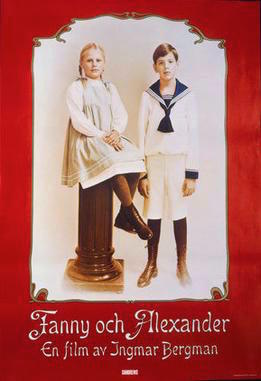
Lungometraggio
Fanny e Alexander
Titolo originale: Fanny och Alexander
19823 h 8 minDrammatico
Perché è su MerryWatch
Wikidata classifica il contenuto nel genere dedicato alla festività (es. film di Natale). La voce del film cita la festa 7 volte.
La festività c'è, ma come sottotrama o cornice.
Metodo: Dato strutturato della fonte
«Genere (Wikidata): a tema Natale»
Fonte: Wikidata · campo «genere»
«…and their well-to-do family, the Ekdahls, live in a Swedish town, running a moderately profitable theatre. At Christmastime, the Ekdahls hold a Nativity play and later a large lively Christmas party. The siblings' parents, Emilie…»
Fonte: Wikipedia (en) · campo «testo della voce» · parole chiave: christmas, christmas party, nativity
«Fanny and Alexander: genere a tema Natale (Q28026639)»
Fonte: Wikidata · campo «genere»
Descrizione
Fanny e Alexander (Fanny och Alexander) è un film del 1982 diretto da Ingmar Bergman.
Nato originariamente come film per la televisione, e licenziato in una prima versione di cinque ore studiata per una eventuale suddivisione in puntate, fu convertito in una versione per il cinema di una durata di circa tre ore; i tagli hanno dato adito a qualche critica circa la inattesa apparizione o la repentina "scomparsa" di alcuni personaggi.
Il film vinse quattro premi Oscar su sei candidature; le candidature per il premio al miglior regista e alla migliore sceneggiatura originale, entrambe riferite a Bergman, non furono coronate da successo, negando al regista l'ultima possibilità di ricevere una statuetta personale per una sua opera.
Altra descrizione (Wikipedia (en))
Fanny and Alexander (Swedish: Fanny och Alexander) is a 1982 period drama film written and directed by Ingmar Bergman. The plot focuses on two siblings and their large family in Uppsala, Sweden during the first decade of the twentieth century. Following the death of the children's father (Allan Edwall), their mother (Ewa Fröling) remarries a prominent bishop (Jan Malmsjö) who becomes abusive towards Alexander for his vivid imagination.
Bergman intended Fanny and Alexander to be his final picture before retiring, and his script is semi-autobiographical. The characters Alexander, Fanny and stepfather Edvard are based on himself, his sister Margareta and his father Erik Bergman, respectively. Many of the scenes were filmed on location in Uppsala. The documentary film The Making of Fanny and Alexander was made simultaneously with the feature and chronicles its production.
The production was originally conceived as a television miniseries and cut in that version, spanning 312 minutes. A 188-minute cut version was created later for cinematic release, although this version was in fact the one to be released first. The television version has since been released as a complete film, and both versions have been shown in theaters throughout the world. The 312-minute cut is one of the longest cinematic films in history.
The theatrical version was released to universal critical acclaim. It won four Academy Awards, including for Best Foreign Language Film; three Guldbagge Awards, including Best Film; and other honours. Fanny and Alexander was followed by stage adaptations and further semi-autobiographical screenplays by Bergman, released as films in 1992: The Best Intentions, directed by Bille August, and Sunday's Children, directed by Daniel Bergman. On both review websites Rotten Tomatoes and Metacritic it is the highest-rated film of the 1980s, and has since then been regarded as one of Bergman's finest works, one of the greatest works of Swedish cinema, and of all time.
Regia e cast
- Regia
- Ingmar Bergman
- Interpreti principali
- Börje Ahlstedt, Anna Bergman, Gunn Wållgren, Kristina Adolphson, Erland Josephson, Mats Bergman, Jarl Kulle, Lena Olin
Da Wikidata: l'elenco del cast può essere parziale.
Contenuti simili
- Rambo, Film · 1982
- A cena con gli amici, Film · 1982
- Gente comune, Film · 1980
- Niki, Film · 1982
- The Story of Voyages, Film · 1983
- Rocky IV, Film · 1985
- Je vous salue, Film · 1985
- Il piccolo Lord, Film · 1980
- Al di là di tutti i limiti, Film · 1987
- Kings and Desperate Men, Film · 1984
- L'amico sconosciuto, Film · 1978
- Profondo rosso, Film · 1975